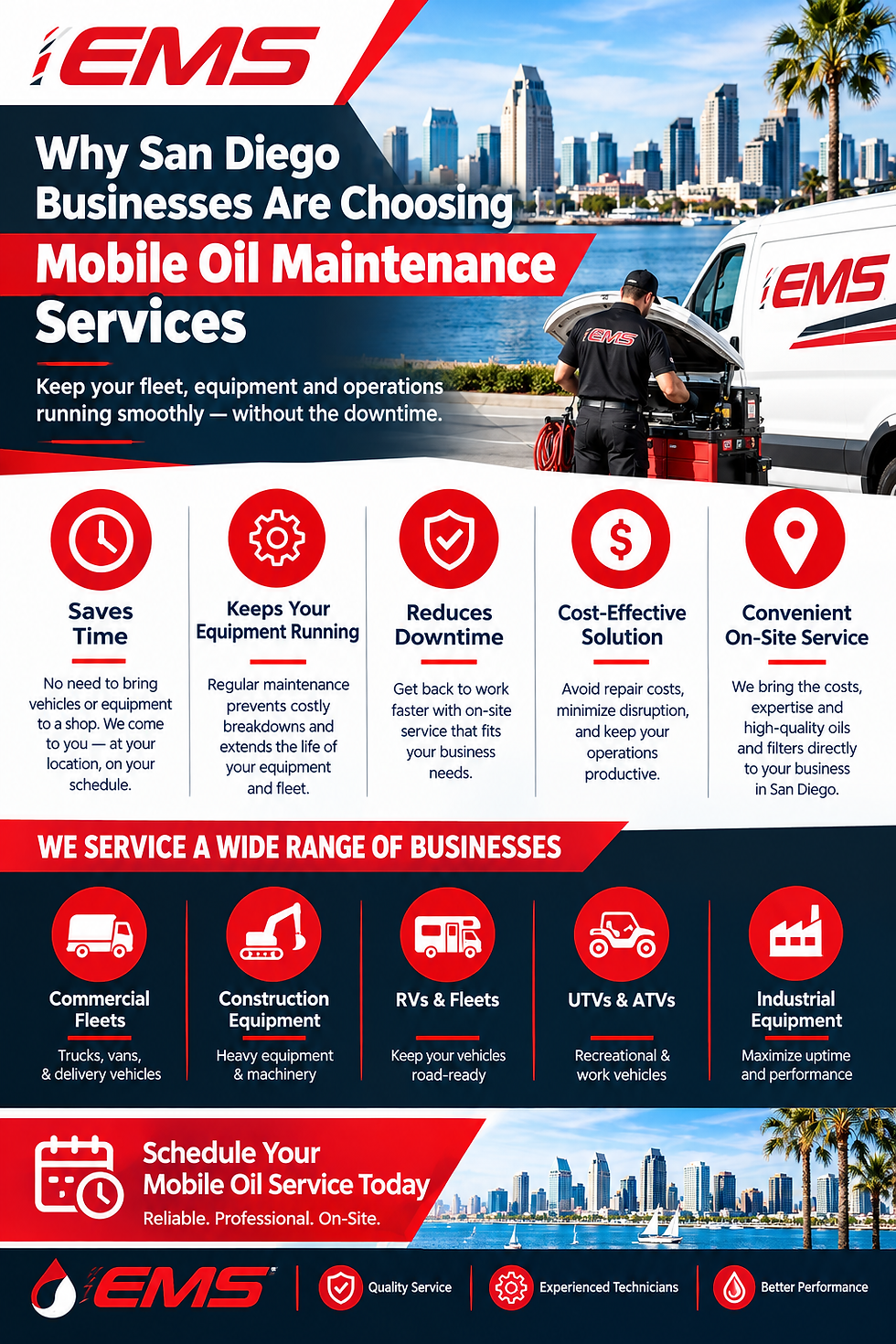
Why San Diego Businesses Are Choosing Mobile Oil Maintenance Services
Every business that relies on vehicles knows the same frustrating math. A van sits in a service-shop lot for half a morning. A driver waits in a lobby, or worse, gets stranded without a ride back to the yard. A technician who should be on a job is shuttling cars across town instead. None of that time shows up on an invoice, yet all of it costs money.
That quiet drain on productivity is the main reason San Diego businesses are rethinking how they handle routine vehicle care. Instead of sending vehicles to a shop, more owners and fleet managers are asking the shop to come to them. Mobile oil maintenance brings a technician and the right equipment directly to a corporate yard, office parking lot, job site, or warehouse, and the work gets done while the team keeps working.
In this guide, we break down exactly why the shift is happening across San Diego County. You will learn what mobile oil maintenance actually involves, how it eliminates fleet downtime, why scheduling flexibility matters, how modern dipstick tube extraction keeps the process clean, and how the approach cuts traffic, fuel use, and emissions. We will also cover which businesses benefit most, how to choose a provider, and answer the questions we hear most often. If you manage company vehicles anywhere in the region, this is the information you need before your next service interval comes due.
What Is Mobile Oil Maintenance?
Mobile oil maintenance is a service model in which a trained technician travels to your location in a fully equipped service vehicle and completes the oil service on site. There is no drop-off, no waiting room, and no second trip to pick the vehicle back up. The vehicle never leaves your property.
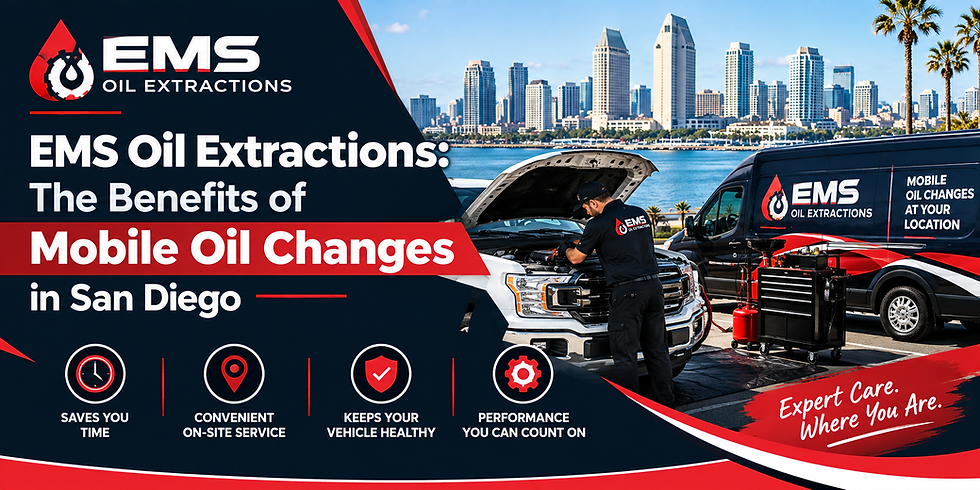
The service itself covers the same essential job as a traditional oil change: removing used engine oil, replacing it with the correct grade and quantity of fresh oil, and addressing the oil filter as the vehicle requires. What changes is the delivery. Instead of lifting a vehicle on a rack and draining oil from underneath, many mobile operators, including EMS Oil Extractions, use an extraction method that pulls the used oil out through the dipstick tube. The oil is collected in a sealed system on the service vehicle, which keeps the process contained and tidy.
Because everything the technician needs travels with them, the work can happen almost anywhere there is room to park: a dealership back lot, a construction staging area, a landscaping company yard, a medical office garage, or a property management lot. For a business, that portability is the entire point. Maintenance becomes something that happens around your schedule, not something your schedule has to be rearranged to accommodate.
If you want a closer look at how this works in practice, our guide to mobile oil change service in El Cajon walks through the on-site process step by step.
Reason 1: Mobile Service Eliminates Fleet Downtime
Downtime is the single biggest reason businesses switch. When a vehicle is at a service shop, it is not earning revenue. A delivery van is not delivering. A service truck is not reaching customers. A sales vehicle is not getting a rep to a meeting. Even a quick traditional oil change can swallow far more than the time it takes to swap the oil once you add the drive to the shop, the wait for an open bay, the service itself, and the drive back.
Multiply that by every vehicle in the fleet, and by every service interval across the year, and the lost hours become significant. A company with ten vehicles that each spend two hours away for every oil service is giving up twenty hours of vehicle time per round of maintenance. Those are hours when jobs could have been completed, customers served, and invoices sent.
Mobile oil maintenance removes most of that lost time. Technicians come directly to your corporate yard, office, or job site, so drivers do not spend hours commuting to and waiting at a traditional shop. The vehicles stay where the work is. In many cases, the service can be completed while a driver is on a break, while a crew is loading, or while the vehicle is parked between routes.
For fleet managers, the benefit goes beyond the clock. It also simplifies planning. Instead of juggling a rotating list of vehicles that are out of service at the shop, you can schedule several vehicles for service in one visit and know exactly when the work will be done. That predictability makes dispatching easier and keeps the entire operation running more smoothly. To see how this applies to your own vehicles, explore our fleet services page.
Reason 2: Teams Stay Focused on Core Operations
Productivity is about more than vehicle availability. It is also about people. When employees are pulled away from their real work to handle vehicle maintenance, the cost shows up in missed calls, delayed tasks, and distracted teams.
Traditional service forces a choice. Either a driver stays with the vehicle and sits in a waiting room for the duration of the service, or someone has to arrange a ride, a loaner, or a pickup. Both options consume the time of at least one employee, and sometimes two. For small businesses, where every person wears several hats, that lost attention can be especially costly.
With on-site service, your people never have to leave. Drivers can keep making calls, finishing paperwork, or preparing for the next stop. Office staff do not need to coordinate alternate transportation. Owners are not forced to personally handle a task that has nothing to do with growing the business. The oil service becomes a background event rather than an interruption.
This matters most for businesses with tight daily schedules: contractors, delivery companies, home service providers, and field sales teams. When your day is built around appointments and routes, a few hours lost to routine maintenance can ripple through the rest of the week. Keeping teams focused on core daily operations is one of the quiet advantages that makes mobile service so appealing to San Diego business owners.
Reason 3: Flexible Scheduling That Fits Your Business Hours
A traditional shop operates on its own timetable, which usually overlaps with the exact hours your vehicles are busiest. If your fleet runs from early morning until late afternoon, there may be no convenient time to drop vehicles off without disrupting your day.
Mobile service flips that dynamic. Appointments can be scheduled during off-hours, evenings, or weekends so there is zero disruption to normal business hours. A fleet that is parked overnight at a yard can be serviced after the last route comes in or before the first driver clocks on. A company that closes on weekends can have its vehicles serviced when the lot is empty, and Monday morning arrives with every vehicle ready to roll.
Flexible scheduling also helps businesses stay consistent. One of the most common reasons vehicles fall behind on maintenance is simple inconvenience. When service means rearranging a day, it gets postponed, and postponed again. When service can happen at a time that costs nothing in lost productivity, owners are far more likely to keep up with recommended intervals.
Recurring schedules make this even easier. Many fleets benefit from a repeating visit, such as a set day each month, so that service becomes part of the operating rhythm rather than another task to remember. If you are ready to set that up, you can reach our team through the contact page to talk through a schedule that fits your vehicle count and hours.
Reason 4: Cleaner, Modern Dipstick Tube Extraction
The method itself is another reason businesses are taking notice. Traditional oil changes drain oil from beneath the vehicle by removing the drain plug. That approach requires lifting the vehicle, positioning a drain pan, and working in a way that can be messy, particularly on busy days.
Many mobile operators use advanced dipstick tube extraction instead. A thin tube is passed through the dipstick channel into the oil pan, and the used oil is drawn out by vacuum into a sealed container. Because nothing is drained from underneath, the process is faster, cleaner, and far less likely to leave stains on your property.
That last point matters for businesses. A parking lot, driveway, or customer-facing property should not end up with drips and spills after routine maintenance. Extraction keeps the work contained within the equipment, so your lot looks the same after the technician leaves as it did before they arrived.
Extraction is also valued for how thoroughly it can pull oil from the pan. Because the used oil is drawn out directly from the bottom of the oil pan, it can help remove more of the sludge and buildup that can settle there over time. The result is a thorough service delivered with less mess and less time on site.
Another practical advantage is that the vehicle does not need to be raised. Technicians can work on vans, trucks, and passenger vehicles right where they are parked, which is helpful in tight yards and lots where lifting equipment would not be practical.
Reason 5: Fewer Trips Means Less Traffic, Fuel, and Emissions
San Diego drivers know the realities of local traffic. The I-5, I-8, I-805, and SR-94 corridors can slow to a crawl at predictable times of day, and a round trip to a service shop can quickly turn into a long detour for a vehicle that should be on the road earning money.
Every one of those trips burns fuel, adds wear to the vehicle, and puts one more car in congestion. When a technician comes to you instead, the fleet skips those service-related trips entirely. Avoiding trips across congested freeways reduces overall fleet fuel consumption and shrinks your carbon footprint.
The benefit scales with fleet size. A business that services dozens of vehicles each year may eliminate dozens of unnecessary round trips, which adds up to real savings in fuel, mileage, and driver time. For companies that track sustainability goals or want to present a greener image to customers, that reduction is a tangible, easy-to-explain win.
It also reduces the less obvious costs of shop trips: the extra mileage, the additional wear on tires and brakes, and the small risks that come with every extra minute spent in traffic. Keeping vehicles on site avoids all of it.
Reason 6: More Consistent Maintenance Means Healthier Vehicles
Regular oil service is one of the most effective ways to protect an engine. Fresh oil lubricates moving parts, helps manage heat, and carries away contaminants. When oil service is delayed, engines work harder, and small issues can grow into expensive repairs and unplanned breakdowns.
Because mobile service removes the usual friction around scheduling, it makes consistency much easier. A fleet manager who can book a convenient visit is far more likely to stay on top of every vehicle. Over time, that discipline supports longer vehicle life, fewer surprise failures, and more reliable operations.
On-site service also gives your team a natural moment to spot developing problems. While a technician is working, it is a good opportunity to note anything unusual, such as low fluid levels or other concerns, so they can be addressed before they interrupt your day. We also recommend keeping a simple maintenance log for each vehicle with the date, mileage, and service performed. A clear record makes planning easier and helps you see at a glance which vehicles are coming due.
If you are not sure how often your vehicles should be serviced, your owner's manual and your vehicles' duty cycles are the best starting points. Vehicles that idle for long stretches, haul heavy loads, or make frequent short trips may need more frequent attention than light highway use.
Beyond Fleets: UTVs, Motorhomes, and Specialty Vehicles
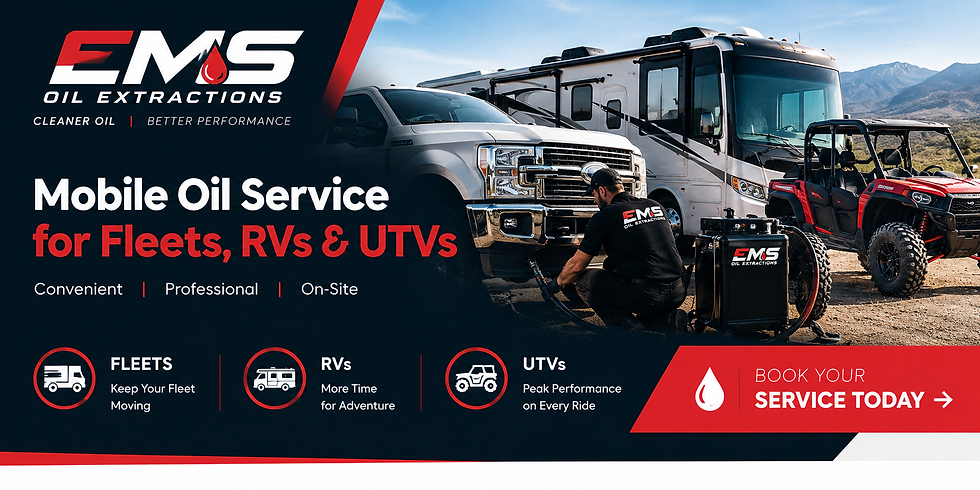
Mobile oil maintenance is not only for delivery vans and service trucks. Many San Diego businesses and owners operate vehicles that are inconvenient to take to a traditional shop. Motorhomes and RVs are large and awkward to maneuver. UTVs often live at job sites, ranches, or recreation properties far from a shop. Work trucks may be needed on a site all day.
On-site service solves each of these problems. A motorhome can be serviced in its storage space or driveway. A UTV can be maintained right where it is used, without loading it onto a trailer. Equipment-heavy businesses can keep their vehicles in the field instead of hauling them to town.
EMS Oil Extractions serves fleet vehicles, UTVs, and motorhomes, which means a business with a mixed set of vehicles can often handle everything through one provider. If you operate off-road or recreational vehicles alongside your standard fleet, take a look at our UTV services page to see how we handle them.
Which San Diego Businesses Benefit Most From Mobile Oil Maintenance?
Any business that depends on vehicles can benefit, but some see the biggest gains:
Contractors and construction companies: Trucks and equipment stay on the job instead of leaving a site for hours.
Delivery and logistics companies: Vans stay on schedule, and maintenance can happen outside delivery windows.
Home service providers: Plumbers, electricians, HVAC technicians, and landscapers keep their crews in the field.
Property management and real estate companies: Vehicles used for site visits and showings can be serviced in the office lot.
Medical and mobile care providers: Staff vehicles stay available for patient visits.
Sales teams and field representatives: Reps do not lose a day of travel to a service appointment.
Rental, tour, and recreation operators: Fleets of RVs, UTVs, and vans can be serviced where they are stored.
What these businesses share is a simple reality: their vehicles are tools, and tools should be working. Mobile oil maintenance respects that by moving the service to the vehicle instead of pulling the vehicle away from the work.
Mobile vs. Traditional Oil Change: A Quick Comparison
Traditional shops still have a place, especially for major repairs that require a lift or specialized equipment. But for routine oil maintenance, the on-site model is hard to beat for any business that values its time.
How to Choose the Right Mobile Oil Maintenance Provider
Not every provider is the same, so it pays to ask a few questions before you commit.
Check the service area. Confirm that the provider covers your location. A San Diego-based company that serves the surrounding communities will usually respond faster than one that travels a long distance.
Ask about vehicle types. If your fleet includes vans, trucks, UTVs, or motorhomes, make sure the provider is comfortable servicing all of them.
Understand the method. Ask how the oil is removed, how it is contained, and how used oil is handled afterward. A reputable provider will explain the process clearly and handle used oil responsibly.
Look for flexible scheduling. Evenings, weekends, and recurring visits are signs that a provider understands business needs.
Ask about fleet support. If you manage multiple vehicles, find out whether the provider can service several in one visit and help you keep a consistent schedule.
Request clear communication. Good providers confirm appointments, arrive when promised, and make it easy to reach a real person.
If you are comparing options, you can also review everything we offer on our services page.
What to Expect From an On-Site Service Visit
The process is designed to be simple for you and your team.
Schedule the visit. You choose a time and place that works for your business, and you tell us how many vehicles need service.
Prepare the vehicles. Park them in an accessible spot with enough room for the technician to work. No lift is needed.
The technician arrives. Your service professional shows up with the equipment, oil, and filters needed for the job.
Oil is extracted and replaced. Used oil is removed through the dipstick tube into a sealed container, and fresh oil is added in the correct amount.
Final checks and wrap-up. The technician completes the service, and your vehicles are ready to go. Your team never had to leave.
Because the process is contained and efficient, many businesses find that service is finished with little or no interruption to their day.
Frequently Asked Questions About Mobile Oil Maintenance in San Diego
What is mobile oil maintenance?
Mobile oil maintenance is a service in which a technician travels to your business, yard, or job site and performs the oil service on the spot. The vehicle never has to go to a shop, which saves time and keeps your team working.
Why are San Diego businesses choosing mobile oil changes?
Businesses choose mobile service mainly to eliminate fleet downtime, keep employees productive, and schedule maintenance outside business hours. Cleaner extraction and fewer trips through congested traffic are additional reasons.
How does dipstick tube oil extraction work?
A thin tube is inserted through the dipstick channel into the oil pan, and a vacuum draws the used oil into a sealed container. Because oil is not drained from underneath, the process is faster and cleaner than a traditional drain.
Can mobile oil service be scheduled after hours or on weekends?
Yes. Mobile service is well suited to evenings, off-hours, and weekends, which lets businesses avoid any disruption to normal operating hours. Contact us to discuss the schedule that works best for your fleet.
Can one visit cover multiple vehicles?
In most cases, yes. Fleet managers often schedule several vehicles for service in a single visit, which keeps planning simple and minimizes the number of appointments needed.
Does mobile oil maintenance work for UTVs and motorhomes?
Yes. EMS Oil Extractions services fleet vehicles, UTVs, and motorhomes, so businesses and owners with specialty vehicles can have them maintained on site.
Is mobile oil maintenance more convenient than visiting a shop?
For routine oil service, almost always. There is no driving, waiting, or arranging rides, and the work happens where your vehicles already are. That convenience is the biggest reason businesses stick with mobile service once they try it.
Keep Your San Diego Fleet Moving With EMS Oil Extractions
San Diego businesses are choosing mobile oil maintenance for reasons that are easy to understand: less downtime, more productive teams, flexible scheduling, a cleaner process, and fewer miles in traffic. When vehicles are tools that drive your income, keeping them on the job and off the shop lot is simply good business.
EMS Oil Extractions is a mobile oil maintenance provider serving San Diego and the surrounding communities, from our base in Lemon Grove. Whether you run a small fleet of work vans, a collection of UTVs, or a single motorhome, we bring professional service to your door.
Ready to stop losing hours to oil changes? Call us at 619-361-7247 or visit EMS Oil Extractions to book your on-site service today.

Comments